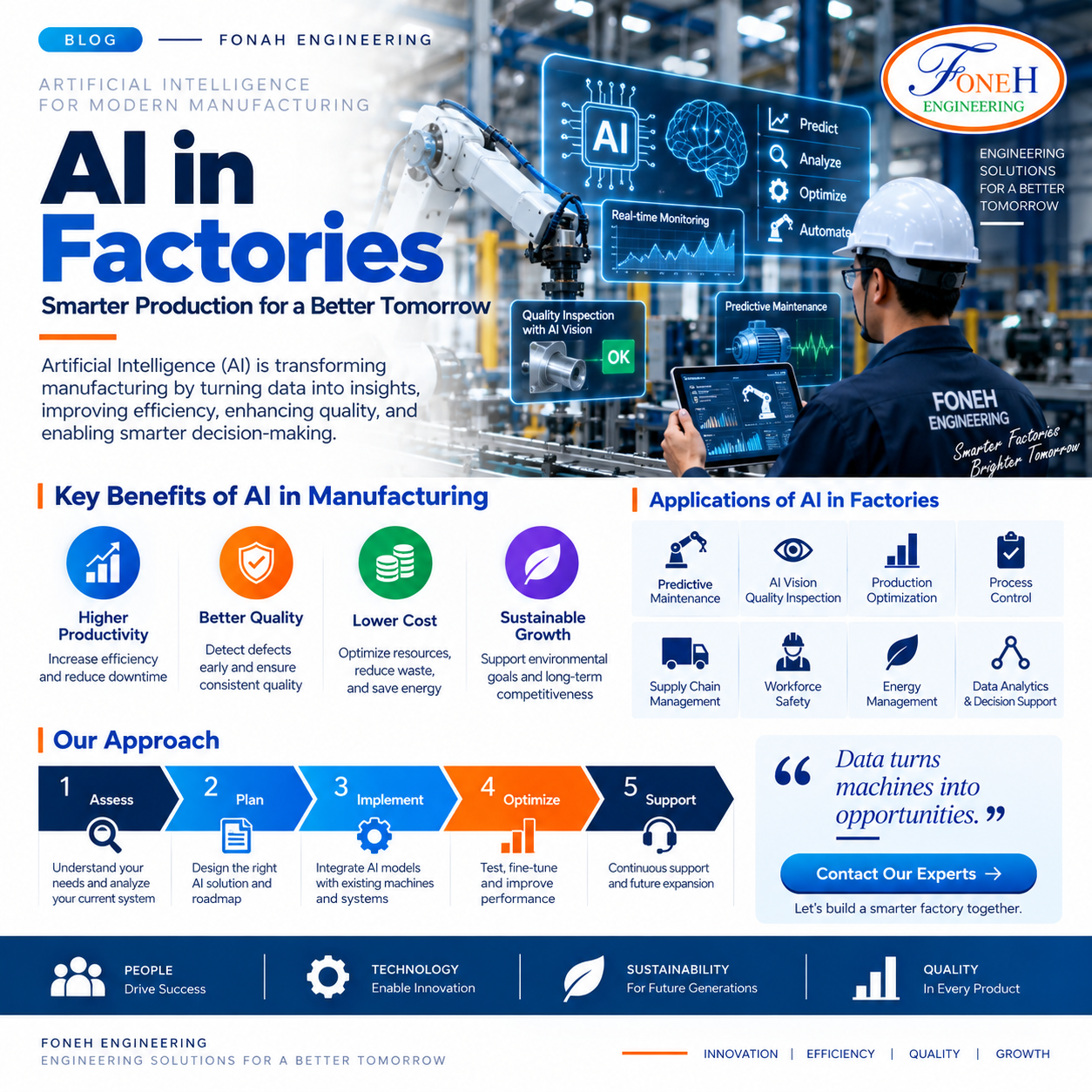
Smarter Production for a Better Tomorrow
Artificial Intelligence (AI) is transforming modern manufacturing by turning production data into actionable insights. When integrated with machines, sensors, automation systems, and production databases, AI can help manufacturers monitor processes, identify problems, predict equipment conditions, improve quality, and support better decision-making.
For FONEH ENGINEERING, AI is not simply a digital technology. It is a tool for connecting engineering knowledge, manufacturing experience, and data to create practical solutions for the industrial sector.
How AI Is Changing Manufacturing
Traditional manufacturing systems often depend heavily on manual inspection, operator experience, and historical production data. AI provides another approach by continuously analyzing data from production processes and identifying patterns that may not be immediately visible.
A modern AI-enabled factory can combine:
Machines + Sensors + IoT + Production Data + AI + Automation
This creates a production environment where information can be collected, analyzed, and used to support operational decisions.
Key Applications of AI in Factories
🔧 1. Predictive Maintenance
AI can analyze machine data such as vibration, temperature, current, operating time, and historical maintenance records to identify abnormal patterns.
This can support maintenance teams in planning interventions before equipment problems lead to significant production disruption.
From Reactive Maintenance → Predictive Maintenance
👁️ 2. AI Vision Quality Inspection
Computer Vision and AI can be used to inspect products automatically.
Systems can analyze images to identify characteristics such as:
- Surface defects
- Incorrect dimensions
- Missing components
- Assembly errors
- Product abnormalities
This enables manufacturers to establish more consistent inspection processes and generate digital quality data.
📊 3. Production Optimization
AI can analyze production data to identify relationships between machine parameters, production rates, downtime, material usage, and product quality.
The resulting insights can support engineers and production managers in optimizing processes and improving overall equipment utilization.
⚙️ 4. Intelligent Process Control
AI can work alongside conventional automation systems to analyze process conditions and provide recommendations for parameter adjustment.
This is particularly useful for complex manufacturing processes where multiple variables affect the final product.
🚚 5. Supply Chain & Production Planning
AI can assist with demand analysis, inventory planning, production scheduling, and material management.
By analyzing historical and current data, organizations can gain better visibility into production requirements and resource utilization.
⚡ 6. Energy Management
AI can analyze energy consumption across machines and production areas to identify patterns and opportunities for efficiency improvements.
This can support factories in reducing unnecessary energy consumption while maintaining production requirements.
The Benefits of AI in Manufacturing
Higher Productivity
AI-based analysis can help identify bottlenecks, downtime patterns, and opportunities for process improvement.
Better Quality
AI Vision and data analytics can support consistent quality inspection and early identification of production abnormalities.
Lower Operating Cost
Data-driven optimization can help reduce waste, unplanned downtime, and inefficient resource utilization.
Sustainable Growth
AI can support more efficient use of materials, energy, machines, and production resources.
Our Approach to AI Transformation
At FONEH ENGINEERING, we believe that successful AI implementation should begin with the real problems of the factory, rather than simply introducing technology.
Our approach can be structured into five stages:
01 — Assess
Understand the factory, production processes, existing machines, available data, and key operational challenges.
02 — Plan
Identify suitable AI applications and develop a practical implementation roadmap.
03 — Implement
Integrate AI models with existing machines, sensors, databases, IoT platforms, and production systems.
04 — Optimize
Evaluate system performance, fine-tune models, and continuously improve the solution using production data.
05 — Support
Provide ongoing technical support and develop additional capabilities as the factory evolves.
AI + Engineering Experience
The value of AI becomes greater when it is combined with engineering knowledge and real manufacturing experience.
Understanding how machines operate, how materials behave, how production processes interact, and how quality is controlled allows AI solutions to be designed around actual industrial requirements.
Our vision is therefore not simply:
“Put AI into the Factory.”
Instead:
“Use AI to Understand, Improve, and Transform the Factory.”
From Data to Intelligent Decisions
A Smart Factory generates enormous amounts of data. The challenge is turning that data into useful information.
Data → Analysis → Insight → Decision → Action → Improvement
AI can become an important layer connecting production data with engineering and management decisions.
“Data turns machines into opportunities.”
FONEH ENGINEERING
Engineering Solutions for a Better Tomorrow
Category: AI in Manufacturing / Smart Factory / Industry 4.0
Tags: AI, Artificial Intelligence, Smart Factory, Industrial AI, Manufacturing, Machine Learning, Computer Vision, Predictive Maintenance, Automation, IoT, Industry 4.0, Data Analytics
Comments are closed